Monday, November 11, 2013

A Trip to the Motor City: Some Residential Areas

This page covers the area that extends from Midtown out to the outer city limits, shaded in yellow below.  Most of this area is (or was)  residential.  Now you're going to see a lot of what you visualize when you think of Detroit. 


Some of the areas we will visit include:
  1. Boston-Edison
  2. Hamtramck
  3. Highland Park
  4. Dexter-Livernois area (where I lived until I was 8)
  5. Palmer Woods
Detroit had no (and still does not have) any rail mass transit, since that would keep people from buying cars, and GM, Ford, and Chrysler wouldn't want that.  So, everybody drove everywhere, which made for massive sprawl, and low density housing.  When I was born, the city of Detroit had 1.95 million people, the vast majority of them living in single-family houses.  Today, there are about 700,000 people living within the city limits.  Below is what happens when you have 700,000 people living in an area that originally held almost 2 million.  Can you see any vacant lots?


Let's start our tour in a residential area that's not so depressing.  The Boston-Edison area (named after the two main streets in the neighborhood) was where the early auto moguls built their mansions.  Most of the houses in the area are in good shape, but there isn't much commercial development (any more) near there.  Here are a few of the houses in Boston-Edison.


To the east is Hamtramck, one of the two cities that are entirely within the border of Detroit.  Hamtramck was at one time almost entirely Polish (and the subject of many local jokes), although other ethnic groups have moved in.  The commercial streets still have a lot of Polish businesses, and the residential streets are modest, but well kept.


Houses in Hamtramck

North of Hamtramck, and still within the boundaries of Detroit, is the city of Highland Park.  Henry Ford built his Model T plant (the first assembly line) in Highland Park, and for many years the area around the factory was a middle-class area.  Not so much any more.

The Model T factory is behind this shopping plaza

Part of the Model T factory


Along Woodward Avenue in Highland Park

Highland Park High School (abandoned)
Highland Park Police Department

Some houses in Highland Park

Now, let's head west, back into Detroit to the Dexter-Livernois area, where I lived until I was 8 years old.  Here's the house I lived in as it appeared in 1999.


Not bad, huh?  Well, here's how it looks in October of 2013


As far as I can tell, the house is empty.  According to the web, it sold for a whopping $24,000 earlier this year.

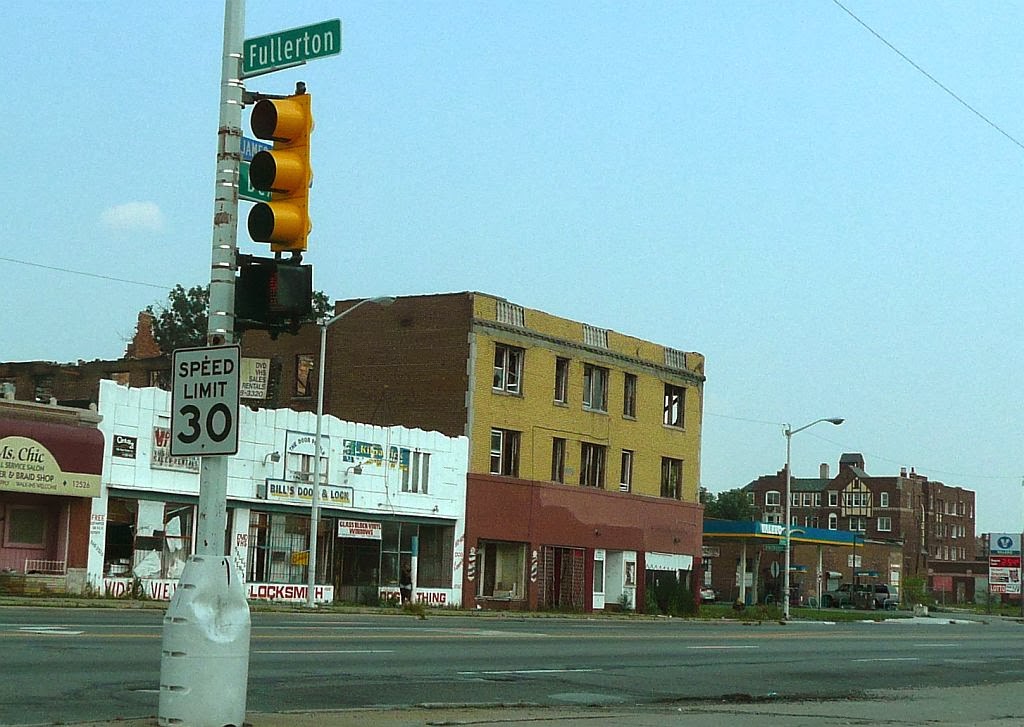
OK, so the house isn't doing that well.  Let's take a walk (a block) down to Dexter, which was the local commercial street when I was growing up.  This is where the corner grocer, drugstore, bank, and restaurants were.

A view down Dexter

The corner drugstore

Where the corner market was

A few more "stores" on Dexter

And, of course, the Dexter Bar

Let's visit the residential areas a couple of blocks from my old house.  

This was a block full of houses at one time


And a few more from Dexter


Lest you think that all of Detroit looks like this, let's go to Palmer Woods, a neighborhood in northwest Detroit.


Unfortunately, even Palmer Woods can't avoid the Detroit syndrome:


Now, let's cross Woodward, about 1/4 mile from Palmer Woods


But a few blocks away.....


A Trip to the Motor City: Midtown

This page covers an area with a radius of about 2 miles outside the downtown area (shaded in yellow in the map below).  This area is a mix of industrial, residential, and cultural. 


Important sites in this area include:

  1. The abandoned Packard Plant
  2. Orchestra Hall
  3. Wayne State University
  4. Detroit Institute of Arts and Detroit Historical Museum
  5. New Center Area, including the Fisher Building and the old GM Building
  6. Motown Museum
  7. Motor City Casino
  8. Site of Tiger Stadium
  9. Michigan Central train station
Just north of Comerica Park (and across the freeway, so it's not in downtown as I defined it), is Brush Park, an area that was originally built in the late 1800's and is near where my grandparents lived when they first came to Detroit in the early 1900's.  Most of the houses have been torn down; a few are still standing but abandoned and rotting, and a few have been restored.  


New housing is being built on a lot of the vacant lots in the area.


No trip to Detroit would be complete without a visit to the old Packard Plant.  If you're old enough to remember (or even if you're not), Packard was a popular car brand that was made in Detroit until the company went out of business in the 1950's.  Since then the building has been mostly abandoned and rotting away.  The city keeps proposing projects to revive it, but none of them ever made it.  As I write this, someone has offered to pay about $2 million for the property, but I'm not getting my hopes up.  If you want to see more of the Packard plant, go to http://www.detroiturbex.com/content/industry/packard/.


Heading up Woodward Avenue from downtown, we encounter the Cultural Center, which includes Orchestra Hall (yes, there is actually a Detroit Symphony Orchestra), and the Detroit Institute of Arts, which is one of the better art museums in the country, unless and until they sell off the collection to pay debts. 

Orchestra Hall

Detroit Institute of Arts
There are also a number of nice old churches and Victorian mansions in various states of repair in this area.


North of the Cultural Center is Wayne State University, one of the largest universities that you never heard of, because they don't have a big-time football team.  Wayne State has about 30,000 students.

Part of Wayne State University
The area around Wayne state is making somewhat of a comeback with a lot of restaurants and shops opening.


On the other hand, not all of Midtown is thriving.


North of Wayne State is the "New Center" area, which was developed in the 1920's.  The main buildings here are the Fisher Building, which contains the Fisher Theater, and the old General Motors Building.  GM has since moved their headquarters to the Renaissance Center and the building now contains city and state offices.

The Fisher Building

The old General Motors Building

A few blocks west of the Fisher Building is the former Motown Studios, which is now the Motown Museum.  You can tour the museum and see where all of the Motown songs were recorded in the 1960's and 1970's.  Yes, it was originally a house.


A few blocks west of the Motown Museum is the Lee Plaza Apartments, which provide luxury accommodations at affordable rates.


Heading back towards downtown, we encounter the Motor City Casino, part of which used to be the old Wonder Bread factory.


Heading south from the casino, we arrive at the site of Tiger Stadium, where the Detroit Tigers played from 1901 to 1999.  It was a dump, but it was our dump.

Tiger Stadium in 1999

Inside Tiger Stadium in 1999
After the Tigers moved to Comerica Park in 2000, they argued for 10 years about what to do with Tiger Stadium.  Eventually, they tore it down about 5 years ago.  However the field is still there and maintained by volunteers.

Goodbye to Tiger Stadium :-(
Tiger Stadium was in an area called Corktown, which was originally Detroit's Irish neighborhood.  There are still a lot of 19th century houses there in various states of repair.  The area is slowly becoming gentrified.

Some houses in Corktown
South of the Tiger Stadium site is another of Detroit's most famous ruins, the abandoned Michigan Central Railroad station.   The last time I went by the station, there was a busload of Japanese tourists taking pictures of it, so I guess it is an attraction of sorts.

Michigan Central Station

 Next: Some Residential Areas


A Trip to the Motor City: Downtown

On the map below, the downtown area is generally thought of as the area between the Fisher Freeway (I-75) and the Detroit River, and bounded on the west side by the Lodge Freeway (state highway 10), and on the east side by the Chrysler Freeway (I-375).


For reference on this page, here are a few major points:
  1. Renaissance Center
  2. Cobo Convention Center/Cobo Arena
  3. Joe Louis Arena (Detroit Red Wings)
  4. Lafayette and American Coney Islands
  5. Compuware Building
  6. Greektown
  7. Hart Plaza
  8. Joe Louis Memorial ("The Fist")
  9. Detroit Police Headquarters (for fans of "Detroit 187" and "Low Winter Sun")
  10. Fox Theater and Hockeytown Cafe
  11. Comerica Park (Detroit Tigers)
  12. Ford Field (Detroit Lions) 

Below is an aerial view (which I stole from the web) taken from above the Detroit River.  The big set of towers in the foreground is the Renaissance Center, which was built in 1973.  The building in the center (with the blue square at the top that says "GM") is a hotel, and the 4 tall buildings around it are mostly GM World Headquarters.   The round building at the far left is part of the Cobo Convention Center (Albert Cobo was mayor of Detroit in the 1950's).  Above that, the building facing diagonally along the river is Joe Louis Arena.

Although it looks good from the air, there are more than a few downtown buildings in various states of abandonment.  On the positive side, the downtown decay is beginning to reverse and there is a lot more activity than there was a few years ago. 


In the picture below, we are looking south toward the river, with the Renaissance Center at the top center along the river.  In the foreground is Comerica Park, and Ford Field (a covered stadium) is to the left.  Across the river is Windsor, Ontario.


Below is a view of downtown taken from the southwest, from Canada.  The Ambassador Bridge, which connects Detroit and Windsor, is in the foreground.
 

Driving along the Jefferson Avenue, which parallels the river, we encounter the memorial to Joe Louis, who was from Detroit.


On the riverfront is Hart Plaza, where concerts and other social gatherings take place.  Over a million people come down to the river to see the 4th of July (and Canada Day) fireworks.


Next to Hart Plaza is City Hall and the Spirit of Detroit statue.   The Spirit has been known to sport a Tigers or Red Wings jersey on occasion.


Joe Louis Arena, home of the Red Wings.  Yes, we see the irony of having a hockey arena named after a fighter.


Possibly the two most famous restaurants in Detroit.  Coney Island hot dogs are the National Food of Detroit (there are literally hundreds of Coney places in the Detroit area), and these are the two that started it all.  Detroit is divided into Lafayette people and American people.  The Kalts are Lafayette people.  If you go to Detroit, you will have a Coney.


The MGM Grand Casino, one of 3 casino/hotels in Detroit.  This one is on the west side of downtown.


The Compuware World Headquarters (below) was one of the first major new buildings in downtown Detroit in recent years, and has sparked a lot of activity and brought a lot of jobs downtown. 


Below is Greektown, which is one of the major restaurant and entertainment areas downtown.  The tall modern building is the Greektown Casino and hotel.


For those of you expecting to see lots of pictures of abandoned skyscrapers in downtown Detroit, I actually had a hard time finding one.  I even did a Google search for "abandoned buildings in downtown Detroit" and almost every hit I got was for a building that had since been renovated or torn down.  The building below (Metropolitan Building) is one of the few still-abandoned buildings downtown.  Don't worry, we'll see lots of abandoned buildings as we move away from downtown.


A detour to Belle Isle.....

Belle Isle is the largest urban island park in the United States, and is located in the Detroit River, just off the lower right corner of the map at the top of the page.  At one time it was one of the nicest parks in the country, but the city can't afford to maintain it, and it has fallen into some disrepair.  Currently, the state of Michigan is trying to take it over and administer it as a state park, which I think would be a good thing.

Below are a few notable buildings on Belle Isle.

Belle Isle Conservatory, a botanical garden and greenhouse

Belle Isle Fountain

Belle Isle Casino, which was a dance hall, not a gambling casino
Back to downtown....

At the north end of downtown is an area called "Foxtown", named for the Fox Theater.  This area has become an entertainment destination, with attractions such as the Fillmore Theater, Comerica Park, Ford Field, and the Detroit Opera House.

Fox Theater and Hockeytown Cafe by Day

Fox Theater at night, viewed from Comerica Park

Comerica Park, viewed from the Fox Theater
Inside Comerica Park

Ford Field--Comerica Park is across the street on the right
The building in the foreground below is the Detroit Opera House, as seen from Comerica Park.


So, there you have downtown Detroit.  I know you're disappointed that you haven't seen the crumbling empty hulks of buildings that you associate with Detroit, but they've actually done a good job of getting rid of them from the downtown area.  There are still a lot of empty storefronts, and I wouldn't walk around downtown at 3:00 AM, but it's not what you think it is.

Next: Midtown

A Trip to the Motor City: Intro

As most of you know, I'm from the Detroit area, and I travel back there 2-3 times a year.  <Insert obligatory Detroit joke here>.  It seems like I spend most of my time defending Detroit and explaining to people that the Detroit area is not (totally) like the image they have of it. 

So, one of my friends said, "you do a blog about every place you go, why don't you do one about your trips to Detroit?"  So, here it is--most of the pictures are from my most recent trip to the Detroit area, in October of 2013.  I have supplemented it with pictures from previous trips, as well as a few pictures I stole off the web.

Unlike my previous blog posts, this is not going to be a day-by-day summary of where I went.  Instead, I am going to have 4 postings that cover:
  • Downtown Detroit
  • The Midtown area, surrounding downtown
  • The rest of the city of Detroit, mostly residential
  • The rest of metropolitan Detroit, outside the city limits
But, first an overview of America's Favorite City.....

A Geographical Introduction to Detroit


Detroit is in the Southeastern part of Michigan, at about the lower joint of the Michigan "thumb".  (You did know that Michigan looks like a mitten, didn't you?)  The city of Detroit is within the red outline on the map.  Here are a few facts that will help you follow the rest of the blog entries:
  • Detroit is part of Wayne County.  The rest of the county consists of the Grosse Pointes, east of Detroit, and a bunch of suburbs (Dearborn, Westland, Redford, and others) to the west. 
    • On the northwest border of Wayne County is Oakland County (Farmington Hills, Southfield, Royal Oak, etc.), which is one of the wealthiest counties in the country. 
    • Northeast of Wayne County is Macomb County (Warren, Eastpointe, St. Clair Shores, etc.), which is mostly middle-class.
  • Detroit is separated from Windsor, Ontario, by the Detroit River, and you actually travel south to get from Detroit to Canada.  If you win any bar bets with this information, please send 15% of the proceeds to me. 
  • Woodward Avenue, (state highway 1), is the "main drag", bisects the city into the east side and the west side, and extends northwest through the suburbs. You are either an East Sider or a West Sider--you can't be both.  I am a West Sider. 
  • The northern border of the city is the (in)famous 8 Mile Road, which shows up as state highway 102 on the map above.   According to the Web, In Detroit, “8 Mile is more than just a street name. It separates Wayne County from its more affluent counties to the north and is the understood divide between the City of Detroit and its white suburbs."
  • On the eastern border of Detroit are Grosse Pointe, Grosse Pointe Shores, Grosse Pointe Park, etc.  This is where the old money is.
  • North of the top of the map are Birmingham and Bloomfield Hills, in Oakland County.  This is where the new money is.
  • There are actually a couple of towns within the boundaries of the city of Detroit.  They are Highland Park (purple rectangle) and Hamtramck (orange rectangle). 
  • Here are a few other famous locations:
    1. Metropolitan Airport--if you have to change planes in Detroit, don't freak out--it's a really nice airport.
       
    2. Henry Ford Museum and Greenfield village, IMHO the best museum in the United States outside of the Smithsonian.
    3. The house  (in Detroit) I lived in until I was 8 years old.
    4. American Jewelry and Pawn (from the show "Hardcore Pawn").
    5. The house (in the suburb of Southfield) I lived in from when I was 8 years old until I was 21 years old.
    6. Comerica Park and Ford Field (for you sports fans)

OK, here we go......

Next: Downtown